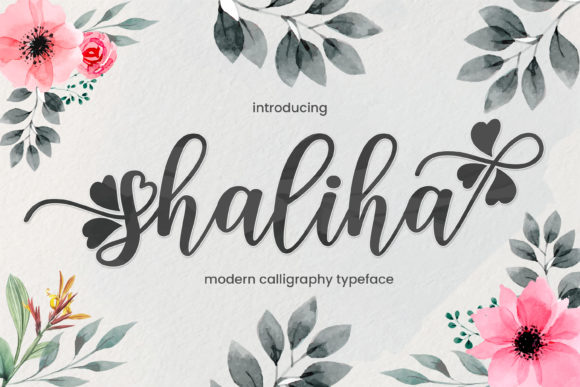
Shaliha Script: A Dainty Handwritten Font for Digital Branding
As a UI designer who ships landing pages, SaaS dashboards, and boutique e-commerce experiences, I reach for Shaliha Script when I need a Script Handwritten typeface that feels human, intentional, and emotionally resonant—not just decorative. This isn’t a generic brush script; it’s a dainty and flowing handwritten font with organic rhythm, gentle contrast, and subtle bounce in its baseline—qualities that translate beautifully to digital interfaces where warmth and authenticity drive conversion.
Shaliha Script for Hero Sections and Conversion-Focused Landing Pages
Shaliha Script excels as a display font in hero sections—especially for creative entrepreneurs, wedding planners, wellness coaches, or handmade product brands. Its sweet and joyful personality instantly softens the tone of a high-contrast layout, guiding the eye toward primary CTAs without competing for attention. Use it at 48–64px on desktop (with tight letter-spacing) for headlines like “You’re Invited” or “Start Your Journey”—then pair it with a clean sans serif (like Inter or Manrope) for body copy. On mobile, scale down to 36px max and ensure line-height stays above 1.3 to preserve legibility against image overlays or gradient backgrounds.
Shaliha Script for Online Store Banners and Product Page Headlines
When designing banners for Shopify or WooCommerce stores—especially for artisanal goods, botanical skincare, or custom stationery—Shaliha Script adds tactile charm without sacrificing clarity. Because it’s PUA encoded, you can access all alternate glyphs (swashes, ligatures, stylistic sets) via CSS font-feature-settings or design tools like Figma—so “Hand-poured Soy Wax Candles” gains graceful entry/exit strokes that reinforce craft and care. Avoid using it for price tags or bullet points; reserve it for short, emotive phrases: “Made With Love,” “Small Batch,” or “Just For You.”
Shaliha Script for Blog Headers and Editorial Web Experiences
For lifestyle bloggers, independent publishers, or course creators building branded web content, Shaliha Script works powerfully as a blog header font—particularly when paired with a neutral serif (like Playfair Display) or functional sans (like Open Sans) for article text. Its flowing structure invites scanning but remains highly legible at 32–40px on light or muted backgrounds. Test contrast carefully on dark mode: avoid pure black-on-white or white-on-black combos; instead, use charcoal (#2D2D2D) on off-white (#F9F7F3) for sustained readability across devices.
Shaliha Script for Portfolio Websites and Creative Brand Kits
If you're a designer, illustrator, or photographer launching a portfolio site, Shaliha Script strengthens visual hierarchy by distinguishing your name or tagline from project titles and case study blurbs. It signals approachability and artistry—ideal for personal branding that balances professionalism with personality. Since it’s a Fonts file with full PUA encoding, you’ll get consistent glyph access across platforms: Figma, Webflow, WordPress (via self-hosted @font-face), and even Canva (uploaded as a custom asset). Just confirm your license covers web embedding before deploying to live domains.
Shaliha Script for Email Headers and Digital Ad Graphics
In email campaigns and static digital ads (Facebook, Instagram, Pinterest), Shaliha Script stands out precisely because it’s not overused—unlike many trending script fonts. Its dainty weight ensures crisp rendering even at small sizes (24–28px), and its joyful flow helps convey sincerity in subject lines like “A Little Note Just For You” or “Your Free Guide Is Ready.” For accessibility, always place it over solid-color or blurred-background blocks—not busy photos—and never rely on it for critical instructions or legal disclaimers.
Shaliha Script for Logo Design and Branded Web Components
While Shaliha Script shouldn’t be used alone for full-word logos requiring scalability (e.g., 16px favicon or app icon), it shines in combination marks—think monogram + script lockup—or as the dominant font in wordmarks for micro-brands: a ceramicist’s shop name, a floral studio’s banner, or a mindfulness app’s splash screen. Its Script Handwritten character supports brand tone without compromising digital legibility, especially when exported as SVG or embedded as a webfont with fallbacks.
Shaliha Script for Mobile App Screens and UI Microcopy
Use Shaliha Script sparingly—but intentionally—in mobile UI: as a celebratory headline after onboarding (“Welcome Home!”), a gentle prompt in a journaling app (“What Made You Smile Today?”), or a decorative accent in a settings menu. Because it’s PUA encoded, you’ll retain control over glyph variants across iOS and Android WebView environments. Never use it for navigation labels, form fields, or error states—stick to system fonts there. Instead, leverage its emotional resonance where users pause, reflect, or convert.
Shaliha Script for Responsive Button Text and Interactive Elements
A common mistake is overusing script fonts in buttons—but Shaliha Script can work beautifully for secondary CTAs when sized correctly: 18–20px on desktop, 16px on mobile, with generous padding and high-contrast backgrounds. Think “Download My Free Checklist” or “Join the Circle.” Always test tap targets: minimum 44×44px on touchscreens. Pair with a lightweight sans serif for hover states or loading indicators to maintain usability.
Shaliha Script for Commercial Licensing and Client-Facing Projects
All Shaliha Script licenses include commercial rights for websites, landing pages, online stores, digital templates, and client deliverables—no per-domain fees or subscription traps. That means you can embed it in a Figma design system, ship it with a Webflow template, or include it in a Notion brand kit knowing it’s fully licensed. Just verify your plan includes webfont files (WOFF2 recommended) and check multilingual support if your audience spans Latin-based languages.